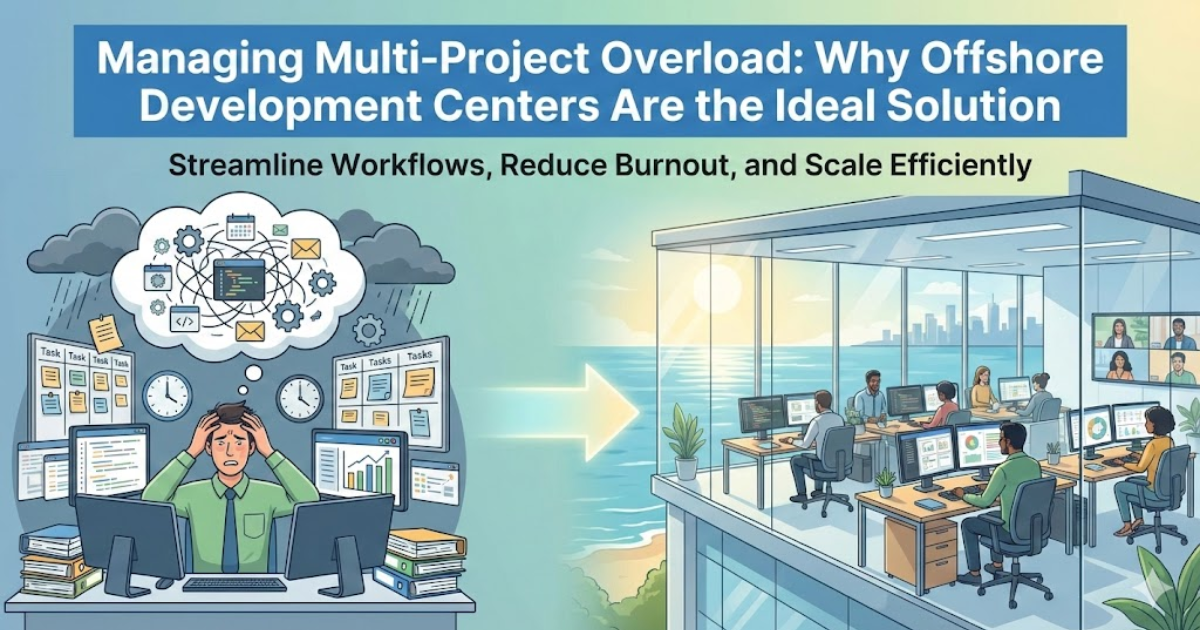
In 2025, a global survey of software companies showed that 68% of firms managed three or more major projects simultaneously. Many reported delays, budget overruns, or quality dips. As demands escalate, development teams often struggle to handle multiple active projects together. This overload can stall innovation, reduce delivery speed, and harm client satisfaction. Based on years of engineering leadership and practical delivery experience, this article explores how an offshore development center (ODC) offers a robust way to manage high project volume without sacrificing quality or timelines.
Here I share technical insights, practical guidelines, and real-world recommendations. I use direct language and active voice to keep clarity.
The Problem: Multi-Project Overload in Software Development
What Causes Project Overload?
Software teams often face overload due to several overlapping factors:
- Client demands increase rapidly.
- Product roadmaps expand without proportional staffing.
- Teams take on multiple small projects alongside large ones.
- Internal maintenance tasks accumulate while new features are pushed.
- Urgent bug fixes or support tasks interrupt planned development.
When teams juggle many assignments simultaneously, resource allocation becomes unstable. Developers bounce between tasks. Context switching increases. Deadlines slip.
Risks of Ignoring Overload
Ignoring overload often leads to:
- Lower code quality and increased bugs.
- Missed deadlines and client dissatisfaction.
- Burnout among core team members.
- Higher turnover when workloads stay heavy.
- Difficulty planning for future projects.
These risks threaten long-term stability. Quality issues may surface after release. At that point, correcting them costs far more time and money than proactive planning.
Why an Offshore Development Center Helps
An offshore development center provides a dedicated, remote but integrated team that works as an extension of your core staff. Many companies choose ODCs when they need to handle multiple projects concurrently without overloading existing staff.
Using an offshore development center gives you access to a larger talent pool and schedule flexibility. It lets you allocate separate teams for distinct projects. It offers a cost-effective way to scale up or down quickly.
When you combine an offshore development center with internal management and strong process discipline, you create a stable workflow that mitigates overload.
Key Advantages of an Offshore Software Development Team
Below are core benefits that make an offshore software development team well-suited to handle multiple projects at once.
1. Distributed Workload Across Teams
When you maintain more than one project, you can assign each project to a separate offshore team. This reduces context switching for individual developers. Teams focus on a single domain at a time. That improves focus, efficiency, and output quality.
2. Flexible Scaling of Resources
Need to scale quickly? An offshore team allows you to ramp up without lengthy recruitment cycles. Need fewer resources later? You can scale down easier than with full-time on-site hires. This flexibility keeps your overhead lean and project costs predictable.
3. Cost Efficiency Without Sacrificing Skill
Labor cost differences in offshore regions still offer savings. You get access to skilled developers at rates often lower than in many local markets. This helps maintain budgets across multiple ongoing projects. The savings allow you to allocate resources where they matter most.
4. Rapid Onboarding and Parallel Project Execution
Because an offshore software development team often works full-time on one project, you can onboard them quickly and run several development tracks in parallel. That speeds up delivery cycles and avoids backlog build-up.
5. Time-Zone and Work-Hour Advantages
If you choose an offshore center in a complementary time zone, you gain “follow-the-sun” development. While one team ends work, another begins. This cycle helps shorten overall development time without overstressing any group.
6. Access to Diverse Skills and Expertise
ODC members may bring specialized skills your core team lacks. They may know certain frameworks, tools, or domain technologies. Assigning projects that require such expertise to offshore teams ensures quality and stable delivery.
How to Set Up an Offshore Development Center for Multiple Projects
Establishing an offshore development center requires careful planning. Below are critical steps and checks to ensure success.
Step 1: Define Clear Project Scope and Requirements
Before you onboard offshore teams, define project goals, requirements, and deliverables clearly. Provide specifications, user stories, acceptance criteria, and any compliance or security constraints. Clear documentation ensures the remote team understands the project fully and avoids rework later.
Step 2: Choose the Right Offshore Partner or Build an Internal ODC
Decide whether you want to partner with a vendor or build your own offshore development center. Evaluate candidate partners or in-house leads based on:
- Past project experience
- Domain knowledge
- Quality standards
- Communication skills
- Staffing flexibility
If you build your own offshore development center, ensure you set up onboarding procedures, coding standards, version control, and collaboration tools from the start.
Step 3: Establish Process Discipline and Standards
Implement consistent development processes. Use version control (e.g., Git), continuous integration and deployment pipelines, automated testing, and code reviews. Maintain coding standards and enforce documentation. Treat the offshore team as equals, not second-tier.
Step 4: Assign Dedicated Teams per Project
Allocate one offshore software development team per major project. Give them autonomy and clear responsibilities. Avoid mixing too many unrelated tasks among the same developers. That ensures focus and reduces context switching.
Step 5: Set Up Regular Communication and Reporting
Schedule regular daily or weekly standups. Use project management tools to track tasks. Ensure time-zone differences do not block critical decisions. Plan overlap hours for real-time discussion when needed.
Step 6: Monitor Workload, Quality, and Burnout Risk
Track metrics like bug counts, task throughput, velocity, and code quality. Watch for signs of overload or repeated rework. Maintain planning sessions to balance workload and avoid long-term stress.
Step 7: Maintain Security, Compliance, and Data Integrity
Ensure offshore teams follow data protection guidelines. Use secure connections, proper authentication, and code reviews. Approve access to sensitive data based on roles. This matters especially for projects with compliance or regulatory requirements.
Best Practices to Maximize Offshore Center Benefits
To get full value from your offshore development center, follow these practices:
- Use modular project design. Break large projects into smaller, independent modules. Assign each module to a dedicated offshore team.
- Maintain shared standards. Enforce uniform coding style, documentation formats, and test coverage across teams.
- Use automated testing and CI/CD tools. Automated builds and tests reduce errors and speed up release cycles.
- Hold regular integration reviews. When multiple teams work concurrently, integrate modules early and test end-to-end frequently.
- Foster shared culture. Treat offshore team members as core contributors. Encourage collaboration, shared ownership, and recognition.
- Set up overlapping work hours. Even one or two hours of overlap helps significantly for daily handoffs, clarifications, and urgent fixes.
- Plan for knowledge transfer. Keep documentation updated. Rotate some senior developers through different projects to cross-pollinate skills and reduce risk of employee turnover.
Potential Challenges and How to Mitigate Them
No solution is perfect. Offshore development centers bring challenges. Below are common issues and mitigation strategies:
Challenge: Communication Gaps
Time-zone differences and cultural barriers can cause misunderstandings.
Mitigation: Define clear documentation standards, schedule regular sync-up meetings, and use collaboration tools (chat, video, version control).
Challenge: Loss of Context or Ownership
Offshore teams might lack deep domain knowledge or feel separated from the core mission.
Mitigation: Include offshore developers early in design sessions. Share product vision and user feedback. Rotate leads to involve them in high-level planning.
Challenge: Quality Variation Across Teams
Different teams may produce varying code quality or follow different standards.
Mitigation: Use shared coding standards, automated linting, code reviews, and periodic audits of modules.
Challenge: Dependency Management Across Projects
Multiple modules and teams can create interdependencies and merge conflicts.
Mitigation: Maintain clear module boundaries, define API contracts, run integration tests frequently, and merge code regularly.
Challenge: Data Security and Compliance Risks
Offshore code or data handling may expose security risks.
Mitigation: Use secure development practices including access control, secure communication channels, encryption, and regular security audits.
Real-World Example: How ODC Resolved Project Overload
Consider a mid-size software firm that accepted three client projects at once: a mobile app, a backend REST API, and a data analytics dashboard. The local team had only ten developers.
Had they tried to handle all three projects internally, they would face delays, context switching, and burnout. Instead, they established an offshore development center.
- They assigned one offshore team to the mobile app, another to backend API, and retained local staff for the analytics dashboard and integration.
- They adopted shared coding standards and automated testing tools.
- They scheduled two overlapping hours daily for sync-up.
- Integration testing occurred every weekend.
Results:
- Each project finished within original deadlines.
- The bug rate stayed low thanks to automated testing.
- The local team avoided overload and continued focusing on core strategic tasks.
- The overall client satisfaction remained high.
This example shows how the right offshore setup solves multi-project overload without sacrificing quality.
When Offshore Development Centers Are Especially Useful
Using an offshore development center becomes highly relevant when:
- Your internal team already handles one or two critical projects and cannot take new ones easily.
- You need to scale quickly for short-term projects without long-term hiring commitments.
- Projects require diverse skill sets that your local team lacks (e.g., a specialized UI framework or backend technology).
- You expect periodic surges in workload (for example, multiple clients with overlapping deadlines).
- You want cost-effective development without compromising code quality or delivery timelines.
In these scenarios, an offshore development center provides flexibility, capacity, and risk mitigation.
Summary
Multi-project overload poses serious risks: reduced quality, delayed delivery, team burnout. Traditional staffing models struggle under heavy and unpredictable workloads.
An offshore development center offers a structured, scalable, and cost-effective solution. An offshore software development team can carry part of the workload, allowing your core team to stay focused on priorities. Setting up an ODC requires careful planning, strong process discipline, good communication, and shared standards. When done right, it handles multiple concurrent projects smoothly and reliably.
For firms that manage many projects at once, an offshore development center often becomes the difference between constant firefighting and stable, predictable delivery cycles.
FAQ
Q1: What exactly is an offshore development center (ODC)?
An offline development center is a remote but dedicated team working full time for your organization. It functions as an extension of your internal team.
Q2: How does an offshore software development team help avoid overload?
It lets you assign separate teams for different projects. Teams focus on one project each. This reduces context switching and prevents burnout.
Q3: Does using an offshore team lower code quality?
Not if you apply strong coding standards, automated tests, code reviews, and ongoing integration. Quality depends on process, not location.
Q4: How can we manage communication with offshore developers?
Use collaboration tools, define overlapping work hours, schedule regular check-ins, and maintain clear documentation. These practices keep communication smooth.
Q5: When does using an offshore center make sense?
When your internal team overloads, you need fast scaling, require specialized skills, or you have many concurrent projects. An offshore center helps handle such situations effectively.